introduction
Social media has become an essential part of modern marketing strategies, enabling businesses and brands to communicate with their audiences, build a digital presence, promote products and services, and reach new customers.
The role of social media is not limited to publishing content. It can also be used to achieve various marketing objectives, such as increasing brand awareness, improving audience engagement, driving traffic to websites, and supporting sales.
Social media platforms differ in terms of their nature and audiences, so the way they are used varies from one platform to another. Content that performs well on Instagram, for example, may not achieve the same results on LinkedIn. The characteristics of the audience and the available marketing tools also vary from one platform to another.
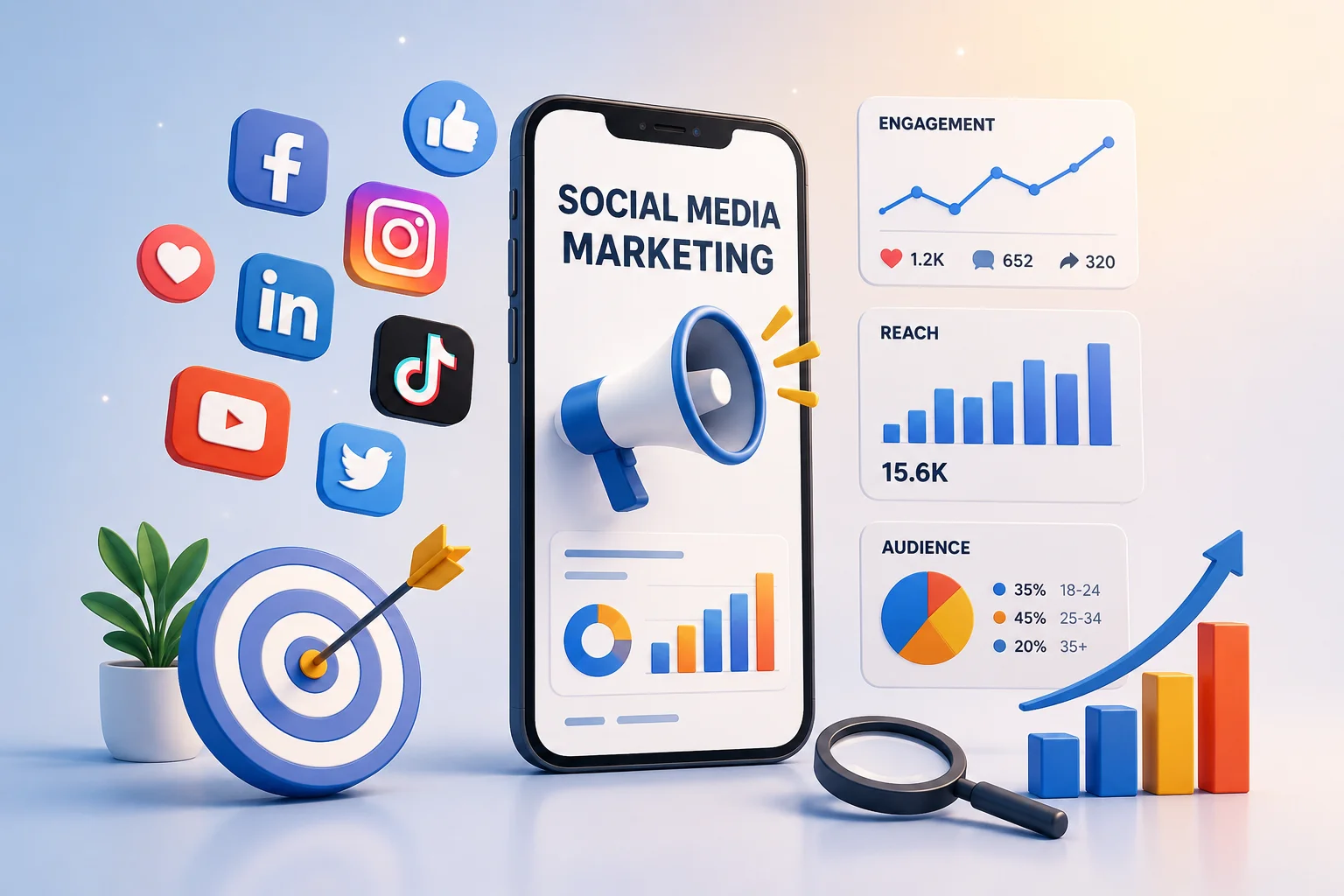
In this guide, we will explore the concept of Social Media Marketing, its importance and objectives, the most popular social media platforms, the types of content used in social media marketing, the difference between organic and paid social media marketing, how to choose the right platform for your business, and the key performance indicators (KPIs) that can help you measure your results.
What Is Social Media Marketing?
Social Media Marketing is the use of social media platforms to promote brands, products, and services, communicate with target audiences, and achieve specific marketing objectives.
It includes creating and publishing content, engaging with followers, building ongoing relationships with audiences, and using paid advertising to reach specific segments of potential customers.
Social Media Marketing is not limited to selling products directly. It can also be used to increase brand awareness, strengthen a brand’s digital presence, build customer trust, drive traffic to websites, support sales, and improve customer service.
The way social media is used varies from one business to another depending on the target audience, the type of products or services, the marketing objectives, and the platforms used by customers.
Why Is Social Media Marketing Important?Social media marketing has become an important part of modern marketing strategies because it enables businesses and brands to reach and communicate with their audiences directly and consistently. It also provides multiple opportunities to promote products and services, build brand awareness, and support sales.
The importance of social media marketing can be seen in several key areas, including:
1. Increasing Brand Awareness
Consistently publishing content helps introduce audiences to a brand, its products, or its services, while increasing the likelihood that customers will remember the brand when they are ready to make a purchase.
2. Reaching the Target Audience
Social media platforms allow businesses to reach different audience segments through both organic content and paid advertising, based on the targeting options available on each platform.
3. Building Customer Relationships
Social media provides direct channels for communicating with customers through comments, messages, and interactive content. This helps businesses build ongoing relationships with their audiences and strengthen trust in the brand.
4. Supporting Sales
Social media can be used to promote products and services and direct customers to websites or online stores. Some platforms also offer social commerce features that allow users to discover and purchase products, depending on the features available in each market.
5. Understanding Audience Interests
Social media platforms provide data and analytics that help businesses understand how audiences interact with their content and identify which types of content perform better. This information can be used to improve marketing strategies.
6. Increasing Content Reach
High-quality content can reach new audiences through shares, recommendations, and the different content discovery features offered by social media platforms. This can increase opportunities for brand exposure.
7. Improving Customer Service
Social media enables businesses to respond to customer inquiries, address feedback, and communicate directly with their audiences, which can contribute to a better customer experience and stronger customer relationships.
8. Measuring Marketing Results
Social media platforms provide tools and reports that help businesses monitor content and advertising performance and measure various performance indicators. This allows businesses to make more informed, data-driven marketing decisions.
Objectives of Social Media MarketingSetting clear objectives is an essential step when developing a social media marketing strategy. Objectives help determine the appropriate content and platforms, as well as the performance indicators that can be used to measure results.
The main objectives of social media marketing include:
1. Increasing Brand Awareness
Businesses use social media to introduce their brands, products, and services to their target audiences, increase visibility, and strengthen their digital presence.
2. Increasing Audience Engagement
Interactive content can encourage audiences to like, comment, share, and engage with a brand, helping businesses build ongoing relationships with their followers.
3. Driving Traffic to Websites
Social media platforms can be used to direct users to websites, blogs, product pages, or service pages, with the goal of increasing traffic and reaching potential customers.
4. Generating Leads
Businesses can use content and paid advertising to attract people who are interested in their products or services and convert them into potential customers who can be contacted later.
5. Increasing Sales
Social media can be used to promote products and services and support sales, either by directing customers to online stores or by using social commerce features available on certain platforms.
6. Improving Customer Service
Social media allows businesses to communicate with customers, respond to inquiries, and address feedback, which can contribute to a better customer experience.
7. Building a Brand Community
Businesses can use social media to build a community of people who are interested in the brand and interact with them regularly, helping strengthen long-term relationships with the audience.
8. Reaching New Audiences
Social media can help businesses reach people who have not previously interacted with the brand through organic content, advertising, and collaborations with content creators.
9. Supporting Product and Service Launches
Social media can be used to introduce new products and services, explain their features, and encourage audiences to try or purchase them.
10. Analyzing Audience Behavior and Improving Strategy
Social media platforms provide data and analytics that help businesses understand how audiences interact with their content, identify what performs best, and use these insights to improve their marketing strategy.
The Most Popular Social Media Platforms for MarketingSocial media platforms differ in terms of their audiences, content formats, engagement styles, and available marketing tools. Therefore, businesses do not necessarily need to use every platform. Instead, they should focus on the platforms that best match their business, target audience, and marketing objectives.
Some of the most popular social media platforms used for marketing include:
1. Facebook
Facebook is a suitable platform for businesses looking to build a digital presence and connect with a diverse audience. It offers various tools for creating content, engaging with customers, running advertising campaigns, and reaching targeted audiences.
2. Instagram
Instagram focuses heavily on visual content, including images, videos, Reels, and Stories. This makes it suitable for brands that rely on visual presentation, such as fashion, beauty, food, and travel businesses.
3. TikTok
TikTok primarily focuses on short-form videos and entertaining content. Businesses can use the platform to reach audiences through organic content, advertising, and collaborations with content creators. Social commerce features are also available in certain markets.
4. YouTube
YouTube is a major video-sharing platform that businesses can use to publish educational content, reviews, tutorials, long-form videos, and short-form videos, in addition to running paid advertising campaigns.
5. LinkedIn
LinkedIn focuses on professional and business-related content. It is particularly suitable for businesses targeting professionals, decision-makers, and other companies, especially in B2B Marketing.
6. X
X can be used to communicate with audiences in real time, share news and updates, and participate in ongoing discussions and trending topics. Its marketing effectiveness depends on the nature of the business and its target audience.
7. Pinterest
Pinterest focuses heavily on discovering ideas, images, and visual content. Businesses can use it to showcase products, ideas, and inspiration, particularly in visually driven industries such as fashion, interior design, and food.
8. Snapchat
Snapchat focuses on short-form visual content and daily engagement. Brands can use it to reach audiences through organic content, advertising, and the interactive content formats available on the platform.
Types of Content in Social Media MarketingSocial media marketing relies on different types of content to attract the target audience, encourage engagement, and achieve marketing goals. The most effective content strategy usually combines several formats rather than relying on one type only. The most common types include:
1. Educational Content
Educational content provides useful information that helps the audience understand a topic, solve a problem, or learn something new. It can include tips, tutorials, guides, how-to videos, and informative posts.
2. Promotional Content
Promotional content focuses on presenting products or services and encouraging customers to make a purchase. It may include product offers, discounts, new product launches, special deals, and limited-time promotions.
3. Entertaining Content
Entertainment-based content aims to capture attention and encourage users to interact with or share the content. It can include short videos, humorous posts, challenges, trends, and creative content related to the brand.
4. User-Generated Content (UGC)
User-generated content is created and shared by customers or users rather than by the brand itself. Examples include product reviews, testimonials, unboxing videos, and customer experiences. This type of content can help build trust and strengthen the relationship between the brand and its audience.
5. Interactive Content
Interactive content encourages users to actively participate rather than simply view a post. Examples include polls, quizzes, questions, surveys, and interactive stories. This type of content can increase engagement and provide valuable insights into audience preferences.
6. Visual Content
Visual content includes images, infographics, illustrations, and other graphic elements used to communicate information in an attractive and easy-to-understand way. High-quality visual content can help capture users' attention and strengthen brand identity.
7. Video Content
Video is one of the most widely used content formats across social media platforms. It can be used for product demonstrations, tutorials, behind-the-scenes content, customer testimonials, educational videos, and short-form entertainment.
8. Live Content
Live content allows brands to communicate with their audience in real time. Live streams can be used for product launches, Q&A sessions, demonstrations, interviews, and special promotions, creating a more direct and interactive experience.
9. Behind-the-Scenes Content
Behind-the-scenes content gives the audience a closer look at how products are made, how a team works, or what happens behind the brand. It can make the brand feel more authentic and help build stronger connections with customers.
10. Storytelling Content
Storytelling uses real or creative stories to communicate a brand's values, experiences, and messages. Instead of focusing only on selling, storytelling helps create an emotional connection with the audience and makes the brand more memorable.
Organic and Paid Social Media MarketingSocial media marketing can generally be divided into two main types: Organic Social Media Marketing and Paid Social Media Marketing. Each type differs in how it reaches audiences, its costs, and the speed at which it can generate results.
1. Organic Social Media Marketing
Organic social media marketing refers to promoting a brand through content and audience engagement without directly paying to distribute posts to a targeted audience.
Examples include:
- Publishing posts, images, and videos.
- Sharing Stories.
- Creating short-form videos.
- Responding to comments and messages.
- Building a community around the brand.
- Using user-generated content (UGC).
Organic marketing can help businesses build long-term relationships with their audiences and strengthen brand trust. However, it may take more time to reach a large number of users and generate consistent results.
2. Paid Social Media Marketing
Paid social media marketing involves using paid advertising on social media platforms to reach specific audiences based on factors such as age, location, interests, behavior, and other available targeting criteria.
Examples include:
- Image and video ads.
- Story ads.
- Short-form video ads.
- Product and e-commerce ads.
- Retargeting campaigns.
- Campaigns focused on increasing traffic, conversions, or sales.
Paid marketing allows businesses to reach larger audiences within a shorter period and provides performance data that can be used to analyze and optimize campaigns.
The Difference Between Organic and Paid Social Media Marketing
Factor Organic Marketing Paid Marketing Cost Does not require a direct advertising budget Requires an advertising budget Reach Depends on followers, algorithms, and engagement Depends on paid campaigns and audience targeting Speed of Results Usually slower Usually faster Building Trust Strong for building long-term relationships Depends on ad quality and user experience Audience Control Depends on platform algorithms and audience engagement Greater control over targeting by age, interests, and location Measurement and Optimization Relies on content and engagement analytics Provides detailed data on campaign performance Benefits of Social Media MarketingSocial media marketing offers many benefits that help businesses and brands reach their target audiences, build a strong digital presence, and achieve their marketing goals. Some of the most important benefits include:
1. Reaching a Wide Audience
Social media platforms allow businesses to reach a large number of users across different markets and locations, helping them expand their potential customer base.
2. Increasing Brand Awareness
Consistently publishing content helps increase brand visibility and introduce audiences to a company's products or services, strengthening its presence in the market.
3. Direct Interaction with the Audience
Social media allows businesses to communicate directly with customers through comments, messages, polls, and live streams, helping build closer relationships with their audiences.
4. Lower Cost of Reaching Audiences
Businesses can use organic marketing to reach audiences without a direct advertising budget. Paid advertising also offers different budget options that can suit a wide range of businesses.
5. Precise Audience Targeting
Advertising on many social media platforms allows businesses to target users based on factors such as age, geographic location, interests, and behavior. This helps businesses reach audiences who are more relevant to their products or services.
6. Increasing Website Traffic and Sales
Social media can be used to direct users to websites, online stores, and product pages, helping increase traffic and support sales and conversions.
7. Access to Data and Analytics
Social media platforms provide analytics tools that help businesses monitor content and advertising performance and measure metrics such as reach, engagement, clicks, conversions, and Return on Ad Spend (ROAS).
8. Building Trust and Credibility
Publishing valuable content, sharing customer experiences, and responding to audience questions can help build trust and strengthen the credibility of a brand.
9. Fast Content Distribution
High-quality content can reach a large number of users within a short period, especially when it generates high levels of views, shares, and engagement.
10. Understanding Competitors and the Market
Social media helps businesses monitor competitors, understand audience interests, track market trends, and identify new opportunities.
11. Building a Community Around the Brand
Brands can use social media to build communities of followers who are interested in their products or services, helping strengthen customer loyalty and encourage long-term engagement.
12. Variety of Content Formats
Social media platforms support various content formats, including images, short-form videos, Stories, live streams, polls, and educational and entertaining content. This gives businesses greater flexibility in communicating with their audiences.
Disadvantages of Social Media MarketingDespite the many benefits of social media marketing, it also presents several challenges that businesses and brands should consider when developing their marketing strategies. Some of the main disadvantages include:
1. High Competition
A large number of businesses and brands are active on social media platforms, making it more difficult to capture and maintain the audience’s attention.
2. The Need for Consistent Content Creation
Social media marketing requires businesses to publish content regularly to maintain audience engagement, which can require significant time, effort, and resources.
3. Changes in Platform Algorithms
Social media platforms may regularly change their algorithms, which can affect content reach and make it necessary for businesses to monitor updates and adjust their strategies when needed.
4. Difficulty Achieving Quick Organic Results
Building an audience and generating results through organic marketing can take time, especially for new brands and accounts.
5. The Need for a Paid Advertising Budget
Businesses may need to use paid advertising to reach larger audiences or achieve specific marketing goals. This requires allocating a budget and continuously monitoring campaign performance.
6. Negative Comments and Reputation Management
Brands may receive negative comments or reviews, which requires professional and timely responses to protect the brand’s reputation.
7. Difficulty Measuring Some Results
Although social media platforms provide many analytics tools, it can sometimes be difficult to determine the direct impact of certain activities, such as brand awareness content, on sales.
8. The Need for Quick Responses
Users often expect businesses to respond quickly to their questions and comments, which can create additional pressure on marketing and customer service teams.
9. Risks of Relying on a Single Platform
Relying heavily on one social media platform can make a business more vulnerable to changes in its policies, algorithms, or available features.
10. The Potential for Negative Content to Spread Quickly
Negative content or customer complaints can spread quickly on social media, potentially affecting a brand’s image if the situation is not handled properly.
11. The Need for Diverse Skills
Successful social media marketing requires a variety of skills, including content creation, copywriting, data analysis, advertising management, and audience communication.
12. Time and Resource Consumption
Managing social media accounts, creating content, responding to audiences, and monitoring analytics and advertising campaigns can require significant time and resources, especially for small businesses.
ConclusionIn conclusion, social media marketing has become an essential part of modern marketing strategies because it provides businesses with valuable opportunities to reach their target audiences, increase brand awareness, build strong customer relationships, support sales, and achieve their business goals.
However, success on social media does not depend simply on creating accounts and publishing content. It requires a clear strategy that aligns with the nature of the business and its target audience. It also requires consistently creating valuable and engaging content, interacting with audiences, monitoring content and campaign performance, and using data to make better marketing decisions.
It is also important to maintain a balance between organic and paid social media marketing and choose platforms that align with the business's goals and target audience rather than trying to maintain a presence on every platform without a clear strategy.
With a structured and measurable approach, social media can become an effective channel for building a strong digital presence, reaching more customers, and supporting long-term brand growth.